What is Gottman Method couples therapy?
If you're researching Gottman Method couples therapy in Sarasota, you have probably done some of the reading already. You may know the Four Horsemen by name, have taken a relationship quiz on your phone, and worked through one of the Gottmans' books together, or at least bought it. That reading is useful. Knowing the research and using it in the middle of your own worst argument turn out to be different skills, and most couples discover the gap somewhere around eleven at night.
Gottman Method at a glance
Gottman Method couples therapy is a structured approach to couples work built on decades of observational research by psychologists John and Julie Gottman. It starts with a formal assessment of how a couple handles friendship, conflict and shared meaning. Treatment then targets the specific patterns that research links to relationships coming apart, and strengthens the habits that keep them together.
Where does the Gottman Method come from?
It grew out of a research lab, from watching real couples, before it became a model of how couples ought to behave. John Gottman, a psychologist and professor emeritus at the University of Washington, spent years with his colleague Robert Levenson watching couples talk through real disagreements while monitors recorded their heart rate and other physical stress responses. The lab became known as the Love Lab. Over four decades, the work came to include more than 3,000 couples, some followed for many years.
John Gottman and his wife, the clinical psychologist Julie Schwartz Gottman, turned those findings into a clinical method and founded the Gottman Institute to train therapists in it.
69%
Perpetual problems
Most of what couples argue about never gets settled. Happy couples argue about it differently.
The finding that matters most to the couples I see is also the one that surprises them. The Gottmans' research found that about 69% of relationship conflict is perpetual: rooted in lasting differences in temperament, values or needs, and never fully solved. Couples who stayed together happily had perpetual problems too. What separated them was how they talked about those problems, which is a far more useful thing to work on than whether you will ever agree about money, punctuality or your mother.
What are the Four Horsemen?
The Four Horsemen are criticism, contempt, defensiveness and stonewalling: four ways of fighting that, in the Gottmans' research, predicted divorce once they became a couple's default. Every couple uses them occasionally. The trouble starts when they become the way you fight.
Here is roughly what each one sounds like in a kitchen in Lakewood Ranch on a Tuesday night.
Criticism
Criticism turns a complaint into a verdict on your partner's character. "I was counting on you to call the contractor" is a complaint. "You never think about anyone but yourself" is criticism.
Contempt
Contempt speaks from above: the eye roll, the sarcasm about your partner's "feelings," the tired "here we go." Couples often don't hear it in themselves until someone in the room names it.
Defensiveness
Defensiveness answers a complaint with a counterattack or an excuse. "Well, I wouldn't have to if you ever..."
Stonewalling
Stonewalling shuts the conversation down: the flat face, the one-word answers, the phone that suddenly needs attention.
Stonewalling is the one most people misread. The Gottmans found that partners who shut down in conflict were usually flooded, meaning physically overwhelmed, with heart rates often above 100 beats a minute. At that point listening stops working, however hard someone tries. From across the table it looks like indifference, and the person shutting down usually feels nothing of the kind.
The remedy the Gottmans teach is a deliberate break, with a time attached so that nobody hears it as rejection. In practice it sounds like this:
"I'm flooded, and if I keep going I'm going to say something I don't mean. I need twenty minutes. I'll come find you at nine and we'll finish this."
Most of the couples I see can read that script and agree with every word of it. Saying it with a racing heart and a partner mid-sentence is the part therapy is for.

What is the Sound Relationship House?
The Sound Relationship House is the Gottmans' model of what a healthy relationship is built from: seven levels, held up by two walls, trust and commitment. The levels run from the ground floor up.
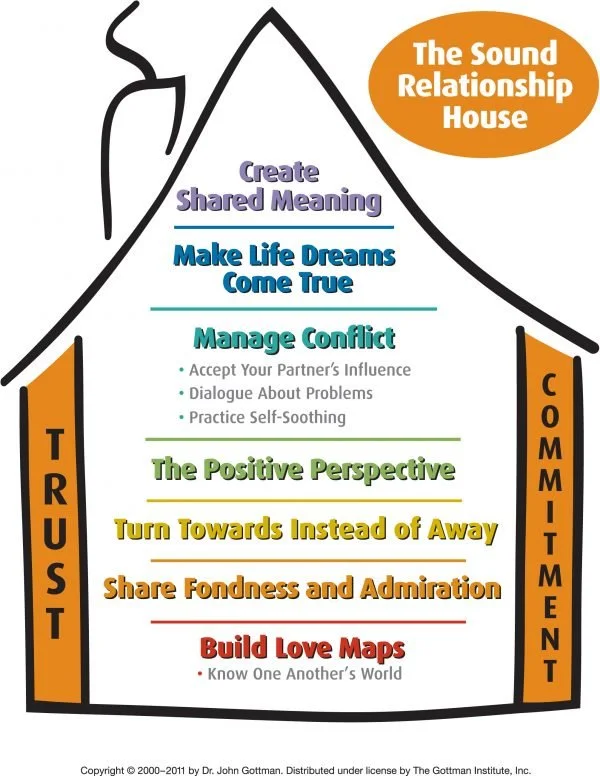
The first three levels are the friendship, and they are where the damage tends to hide. Couples usually arrive asking for help with level five, the fighting. The assessment often shows the trouble started lower down, with love maps that stopped being updated sometime around the second child or the second company.
You can know your partner's calendar in detail and have no idea what they worry about at three in the morning, and a great many capable couples are in exactly that position.
What happens in the first few sessions?
The first few sessions are an assessment, and the work of changing anything starts after it. Over roughly three or four meetings, I get to know the relationship from several angles.
1
Together
We begin together. I'll ask how you met, what drew you to each other, and what brings you in now, and I'll ask the two of you to talk through a real disagreement while I watch how it unfolds.
2
Individually
Then I meet with each of you individually, which gives each person room to say what is harder to say with a partner listening. You'll each complete the Gottman Relationship Checkup, a detailed online questionnaire that maps where the relationship is strong and where it is under strain.
3
Feedback
The assessment ends with a feedback session. I lay out what I've seen across the Sound Relationship House, what is working, what isn't, and the plan for treatment. Capable people tend to appreciate this part, because it replaces a vague sense that things are off with a specific account of where they are off.
That account is honest. If one of you is carrying more of the problem than the other, I'll say so, to both of you.
Is Gottman therapy just learning communication techniques?
The techniques are part of it, and for most couples they aren't enough by themselves. The research identifies which patterns tend to damage relationships. It can't explain why this particular couple keeps running one of them.
Many of the people I see could explain a repair attempt better than most self-help books and still can't make one at home. Usually that's because the argument about the dishwasher is standing in for something older: a parent who never apologized, a first marriage that ended badly, a lifelong habit of being the one who handles everything. My clinical foundation is psychodynamic, so I'm as interested in what a pattern protects as in how to interrupt it.
I'm trained in the Gottman Method at Level 3, I'm a certified leader of the Gottmans' Seven Principles program, and I've trained in their approach to treating affairs and betrayal. I'm also trained in Emotionally Focused Therapy, discernment counseling and financial therapy, and money gets discussed openly rather than referred out. The Gottman framework gives the work its structure and a shared language. What happens inside that structure depends on the two people in the room.

Signs to take seriously
How do we know it's time for couples therapy?
It's time when you can see the pattern clearly and still can't stop it. Insight is usually not what's missing for the couples I see. They describe their own argument with real precision, and then they have it again on Thursday.
Some signs make it more pressing:
- The same fight has been running for months with no new information in it.
- Contempt has started showing up in the jokes or the tone.
- One of you goes quiet in nearly every hard conversation, and the other has stopped trying to start them.
- There has been a betrayal: an affair, an emotional affair, a financial secret, a major decision made alone that should have been made together.
Sometimes one of you is further out the door than the other. Ordinary couples therapy assumes both people want to repair the relationship, and when that assumption is wrong, the sessions tend to make things worse. If you've started privately picturing life after the marriage, say so in the first session. Discernment counseling was designed for exactly that situation, and it's often the more honest place to begin.
If you recognize your relationship in any of this, the assessment is a reasonable first step, and you can book a consultation through Reclaim.
Book a consultationAbout the author
Julia Loewi
I'm Julia Loewi, MSW RSW LCSW-QS CFSW, a psychotherapist, licensed clinical social worker and Florida Qualified Supervisor. I see couples at Reclaim's offices in Sarasota and Lakewood Ranch, and virtually across Florida and Ontario. Before Florida I spent more than 15 years at Canada's largest mental health and addictions teaching hospital, and ten years teaching and supervising graduate clinicians at the University of Toronto. Most of my work is with couples who are, by most measures, doing well, and are stuck anyway. Reclaim is private pay. Learn about couples therapy at Reclaim.
Questions
Frequently asked questions
How long does Gottman Method couples therapy take?
It depends on what the assessment finds, and the feedback session is where you get a realistic estimate. Some couples need a few months of weekly sessions to change a specific pattern. Recovery after an affair or a long stretch of distance usually takes longer, because trust is rebuilt through repeated experience rather than one good conversation.
Is Gottman therapy only for couples in crisis?
No. Plenty of couples start because the relationship has gone quiet rather than combative: polite, efficient and lonely. The Gottmans' research on friendship and turning toward each other applies directly to that kind of distance, and it is easier to address before resentment has had years to settle in.
Can we do Gottman Method therapy online?
Yes. I offer virtual sessions for couples anywhere in Florida and Ontario, and the method translates well to a screen. The Gottman Relationship Checkup is completed online in any case, and the conflict discussions that matter most are as visible on video as they are in my Sarasota or Lakewood Ranch office.
Does Gottman therapy work after an affair?
The Gottmans developed a specific approach to affair recovery, and I've trained in it. The work moves through three stages: atonement, attunement and attachment. It starts with honesty about what happened and whether it has ended, because repair can't begin while the betrayal is still going on.
Does insurance cover Gottman Method couples therapy?
Reclaim is private pay, so I don't bill insurance directly. Where out-of-network reimbursement applies and is clinically appropriate, I can provide a superbill to submit to your insurer. Coverage for couples therapy varies widely between plans, so it's worth checking your out-of-network benefits before your first session.