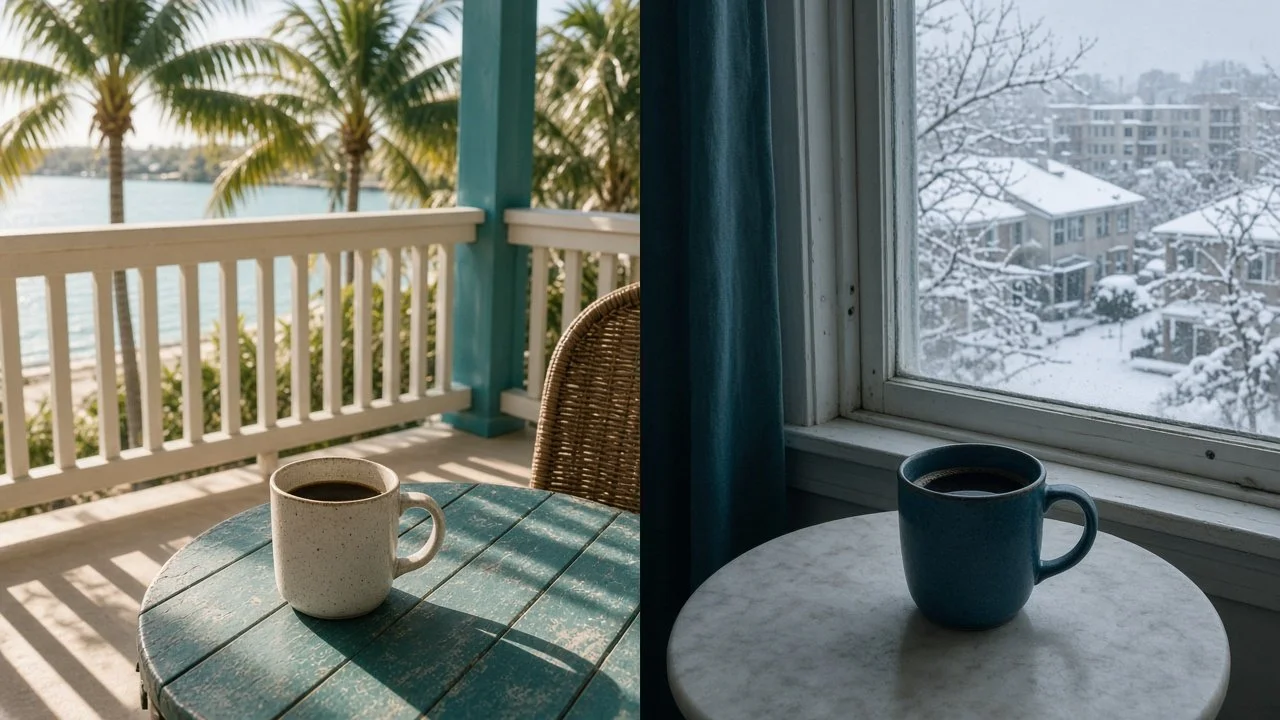
When your marriage lives in two places, or one of you lives across the border, therapy can follow you both
There are two versions of this. In one, you go south in November and north in April together, and the marriage travels with you. In the other, a border runs between you, one in Toronto and one in Sarasota, and you see each other every five or six weeks. If you're lucky.
Either way, something between you has been getting quietly worse, and the arrangement has made it easy not to deal with it.
You are not short on contact. You text through the day and talk most evenings. The one conversation that needs to happen keeps getting moved, and it has been moved so many times that neither of you is sure how to raise it now.
When you move between two homes together
The logistics of a two-country life are usually handled well. Two houses, two sets of doctors, a routine that packs itself by now. The marriage travels less cleanly.
Your friction is seasonal, and a Gulf Coast winter hides it well. The work pressures that generate most of your conflict stay behind in Ontario. There is more daylight, more social life, and far less to negotiate in a day, so February can feel like the two of you are fine.
John and Julie Gottman, the psychologists whose observational research on couples spans four decades, found that most of what couples argue about never gets solved. These are perpetual problems, differences in temperament, pace, or need that get managed rather than resolved. A quiet winter doesn't resolve one. It gives it a quiet stretch.
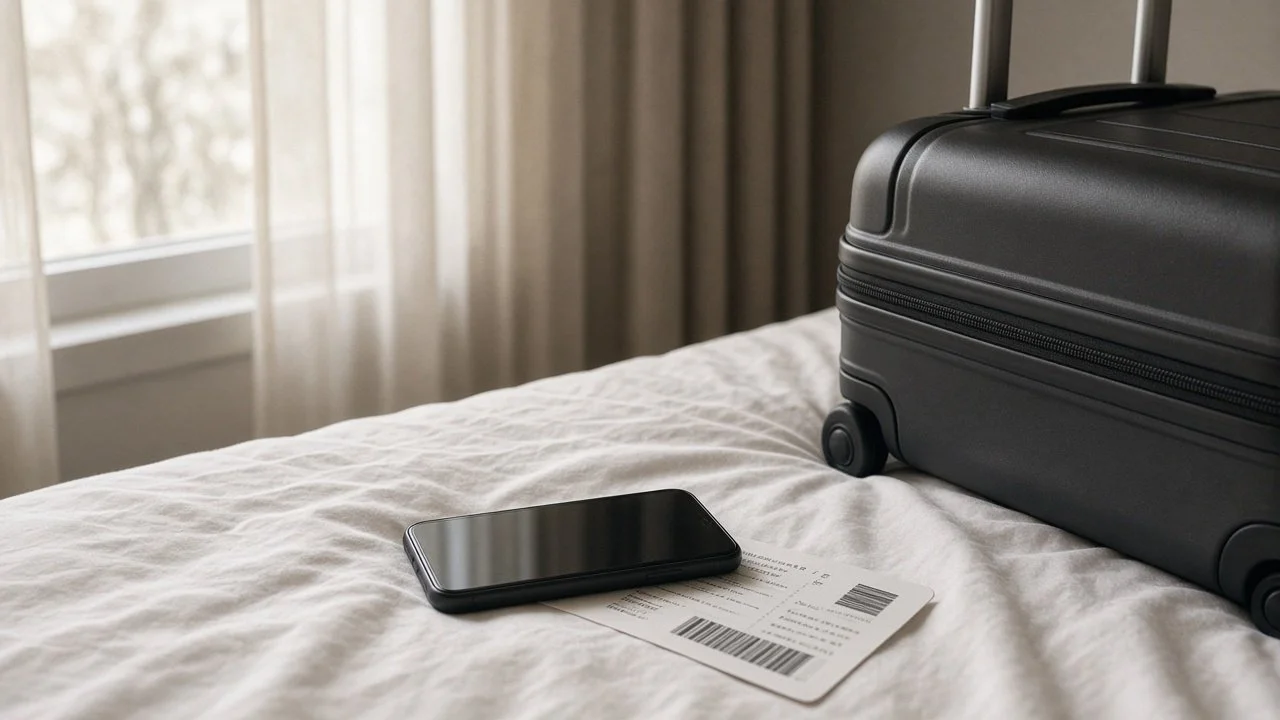
Across a border, conflict gets rationed
When you live together, disagreements surface on their own. Someone leaves a cupboard open, the wrong tone lands at the wrong hour, and you deal with it or you don't, but it happens in the open.
At five weeks between visits, nobody wants to spend a Friday-to-Sunday on the thing that has been bothering them since August. It waits through the visit, then through the five weeks after. By the time it comes out, it has turned into evidence of a pattern, which is a much harder conversation to have in a hotel room on a Saturday morning.
Two other things happen reliably. The hard conversations move to text, where tone disappears and both of you read the worst available version of a short message. And the visit has to carry too much. A weekend is expected to deliver connection, sex, logistics, family obligations, and the repair of whatever went unspoken for a month. Both of you feel that weight arriving at the airport, and neither of you says so, because the visit is supposed to be the good part.
The decision underneath
For couples living apart, the distance usually sits on top of an unmade decision about where this ends up, and it has stayed unmade longer than either of you admits.
It covers where you will actually live, whose career bends, whose parents end up two hours away and whose end up on a plane, and who gives up a house, a license, a practice, or a circle of friends built over fifteen years.
Usually one of you has a firmer answer than the other has heard. Sometimes one of you decided privately two years ago and has been waiting for conditions to make it obvious. Say it out loud. The distance has made that conversation easy to postpone, and the postponement is doing its own damage.
Snowbird couples have a version of this too: the question nobody raises about what happens when one of you can no longer manage the move, or wants to stop making it.
What each of you owns
Couples in both arrangements arrive with a clean story about whose fault it is. The one who took the job. The one who won't move. The one who goes distant on calls. The one who checks in too much. The one who wanted Florida in the first place.
Each version is usually accurate and none is complete. A reaction never happens in a vacuum, so the question I put to both of you is what part is yours. Sometimes one person is doing more of the damage, and I will say so. The part you can change is your own.
The second half matters as much as the first. A request for change has to come with where you can meet the other person. Without that, it is a demand delivered from a different country, and those rarely land.
“Here is what needs to change. And here is where I can meet you.”
Specifics instead of "more connection"
"We need to feel more connected" gives neither of you anything to do. These can be done:
- A standing call that does not get moved for work.
- An agreement that difficult subjects wait for video rather than text, since tone disappears in a short message.
- The first evening of a visit held for the two of you before anyone's family gets it.
- A date by which the question of where you will live gets answered, even if the answer is that you need another year.
- For snowbirds, a decision about which conversations are allowed to cross the seasons instead of being left behind in each house.
Vague asks fail in any marriage. At this distance they fail faster, because there are fewer unplanned moments for anything to happen by accident.

Why two licenses matter
Therapy follows where you are sitting during the session, which makes this a licensing question before it is a clinical one. I hold both credentials. In Florida I am a Licensed Clinical Social Worker and Qualified Supervisor, LCSW-QS #SW23346. In Ontario I am a Registered Social Worker and psychotherapist, a member in good standing of the Ontario College of Social Workers and Social Service Workers, #814213. I spent over fifteen years at CAMH in Toronto, so both sides of this arrangement are familiar ground.
That lets me run joint sessions with each of you in a different jurisdiction, and it lets a snowbird couple keep working through the months they spend north.
How sessions work
In-person sessions are held at 1266 First Street in Sarasota or 9040 Town Center Parkway in Lakewood Ranch. Virtual sessions are available anywhere in Florida or Ontario. Many clients meet in person through the winter and continue virtually from Ontario in the summer.
For couples living apart, each of you joins from wherever you are, provided that is Florida or Ontario, and it does not have to be the same one. When you are together in Florida, you come into the office.
Reclaim is private pay. Some Ontario extended health plans cover services from a Registered Social Worker, and receipts are provided for you to submit. Superbills are available where out-of-network reimbursement applies and is clinically appropriate.
Where to start
Couples in both situations tend to wait until they are in the same place. For snowbirds, that means after the move, when the season has already smoothed things over. For couples living apart, it means after someone relocates, which is the decision you need help making.
If you are each in Florida or Ontario this week, you can start from where you are. The Florida and Ontario therapy page covers the logistics, and a short consultation sorts out the rest. Request a confidential consultation from either side of the border.
Starting from two places is fine.
Request a confidential consultationJulia Loewi is a psychotherapist and the founder of Reclaim, with offices in Sarasota and Lakewood Ranch, Florida. She spent more than fifteen years at CAMH in Toronto and ten years supervising clinical interns at the University of Toronto. She is licensed in both places, as an LCSW-QS in Florida and a Registered Social Worker in Ontario, so she can see couples in person through the winter, continue virtually when they go north, and work with partners who live on opposite sides of the border. Her couples work draws on the Gottman Method, Emotionally Focused Therapy and discernment counseling.